
How Artists Memorialize War
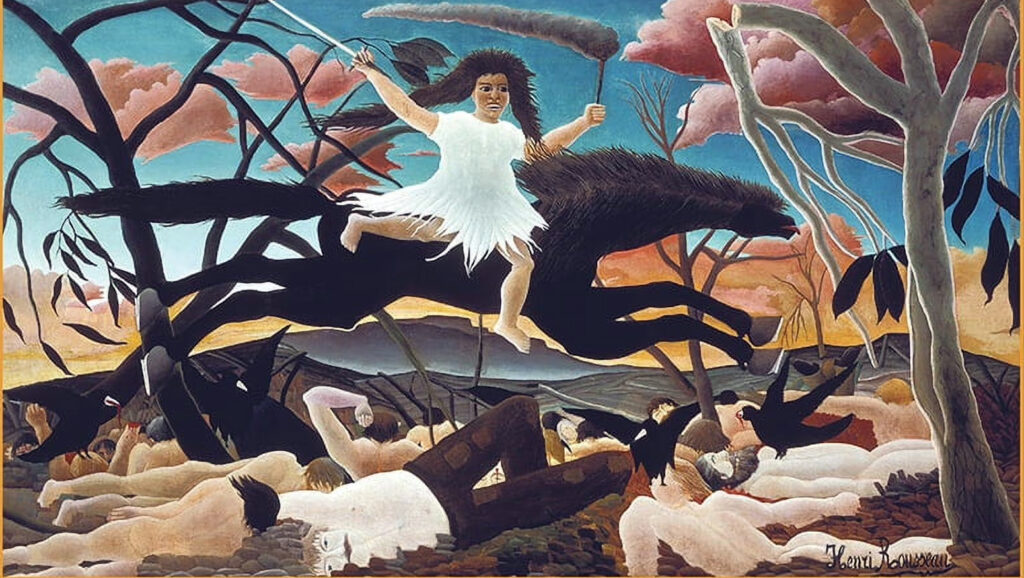
Henri Rousseau, War, 1894
Henri Rousseau hasn’t been on my radar until recently, but now that I see more of his work, it has sparked my interest and I am looking forward to seeing Henri Rousseau: A Painter’s Secrets exhibition at the Barnes Foundation in Philadelphia through Feb. 22, 2026. His pictures of forests and animals were familiar, but a very large 45 x 77 inch bold painting War startled me. It is so different from both his figurative and his landscape paintings.
1894, Speaking of Henri Rousseau’s War painting, the young painter Louis Roy wrote in Le Mercure de France: “this picture may well appear strange because it does not evoke anything seen before. Is that not in itself a masterly quality? [Rousseau] has the rare merit today of having a style that is completely his own. He is moving towards a new art”. It is a hallucination in unnatural colors of high contrast tell a story of violence and death.
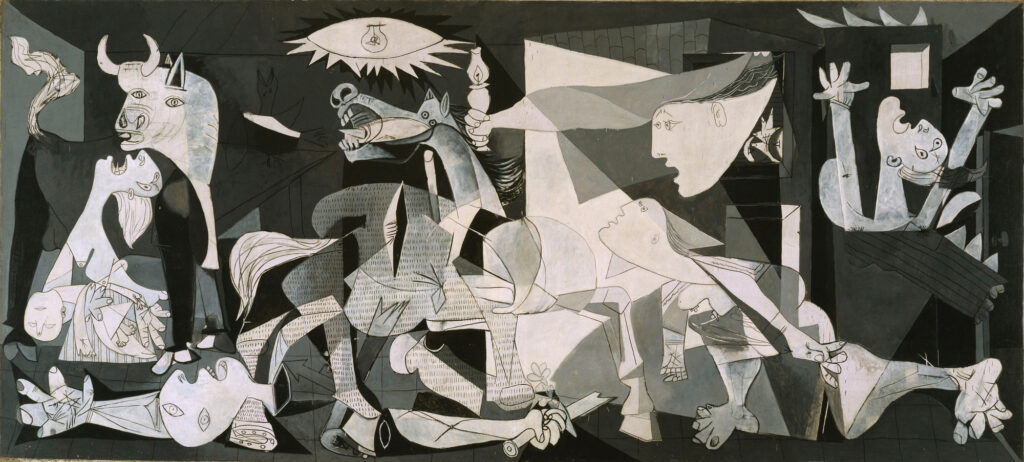
Picasso, Guernica, 1937
Upon seeing Rousseau’s highly active painting, Picasso’s painting gray Guernica, painted in 1937 forty three years later, leapt into my mind’s eye. Painted in response to the Spanish Civil War, Guernica also shows the tragedies of war and the suffering inflicted upon individuals, particularly innocent civilians. Guernica is blue, black and white, 11 ft tall and 25.6 ft wide, a mural-size canvas painted in oil. I am curious to know if Picasso ever saw Rousseau’s War.
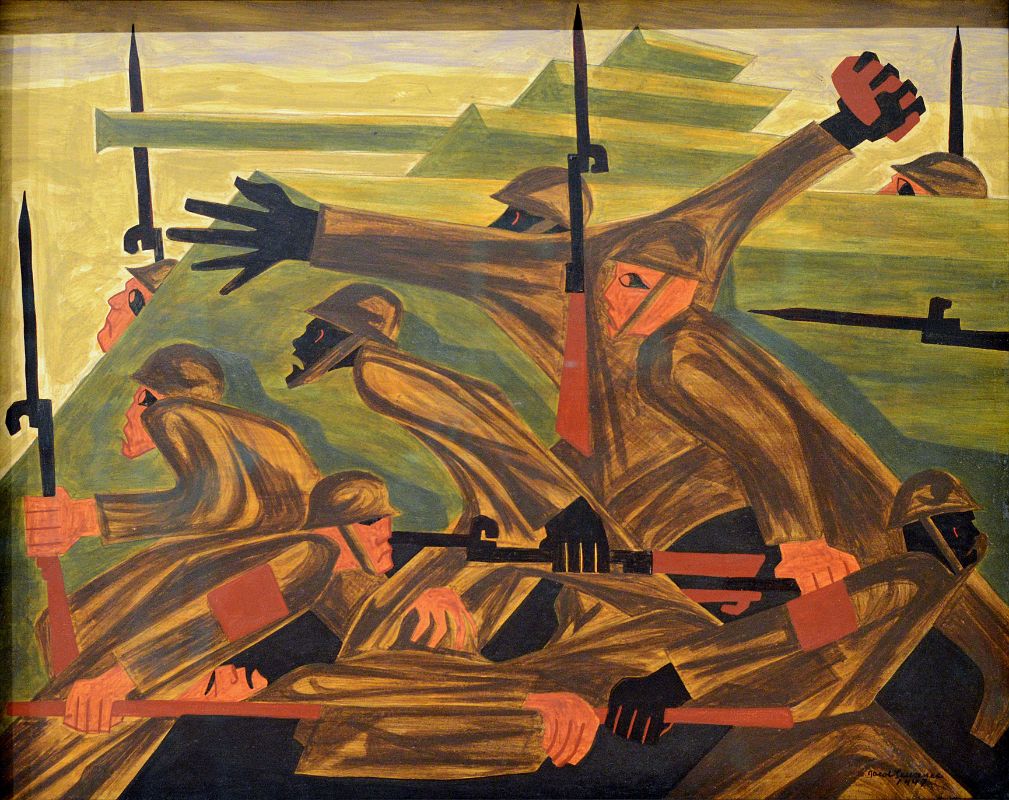
Jacob Lawrence, 31 War Series Beachhead, 1947
Neither of these two painters served in armies, but their understanding of the horrors of war is undeniable. Ten years after Picasso’s painting was unveiled and touring the world, Jacob Lawrence, a Black American, began to paint War Series in which he describes first-hand the sense of regimentation, community, and displacement that the artist experienced during his service in the United States Coast Guard during World War II. Lawrence served, first in a racially segregated regiment and then in an integrated regiment as Coast Guard Artist, documenting the war in Italy, England, Egypt, and India. 1n 1946 he received a Guggenheim Fellowship to paint the War Series of which 31 War Series Beachhead is an example. It’s a much smaller 15 7/8 × 20 1/16 inches, but no less dynamic in its presentation of soldiers in action through bold, abstracted, monochromatic forms locked in the immediacy of the fight.
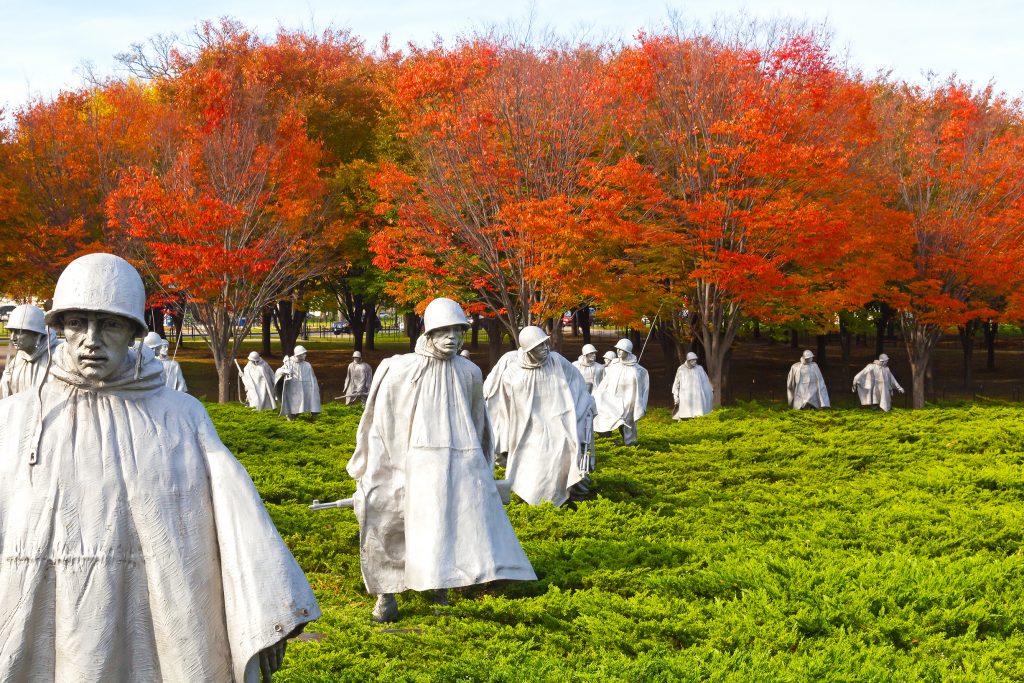
Don Leon, John Lucas, Frank Gaylord, Louis Nelson, Korean Veteran’s Memorial, 1955
Rather than actual fighting, the long-haul slog of soldiers in snow or rain is the theme of the 1995 Korean War Veterans Memorial by Don Leon and John Lucas; figures sculpted by Frank Gaylord and Louis Nelson. On the lookout and donned in rain gear, they head toward a circular pool of water surrounded by, or perhaps sheltered by tall sculpted trees.
In this 1950-53 war, the United States sent troops to join ally South Korea after it was invaded by the north. This Asian conflict was marked by significant international involvement and resulted in millions of casualties, ultimately leading to a division of the Korean Peninsula even today. The Washington DC memorial honors America’s “sons and daughters who answered the call to defend a country they never knew and a people they never met.”
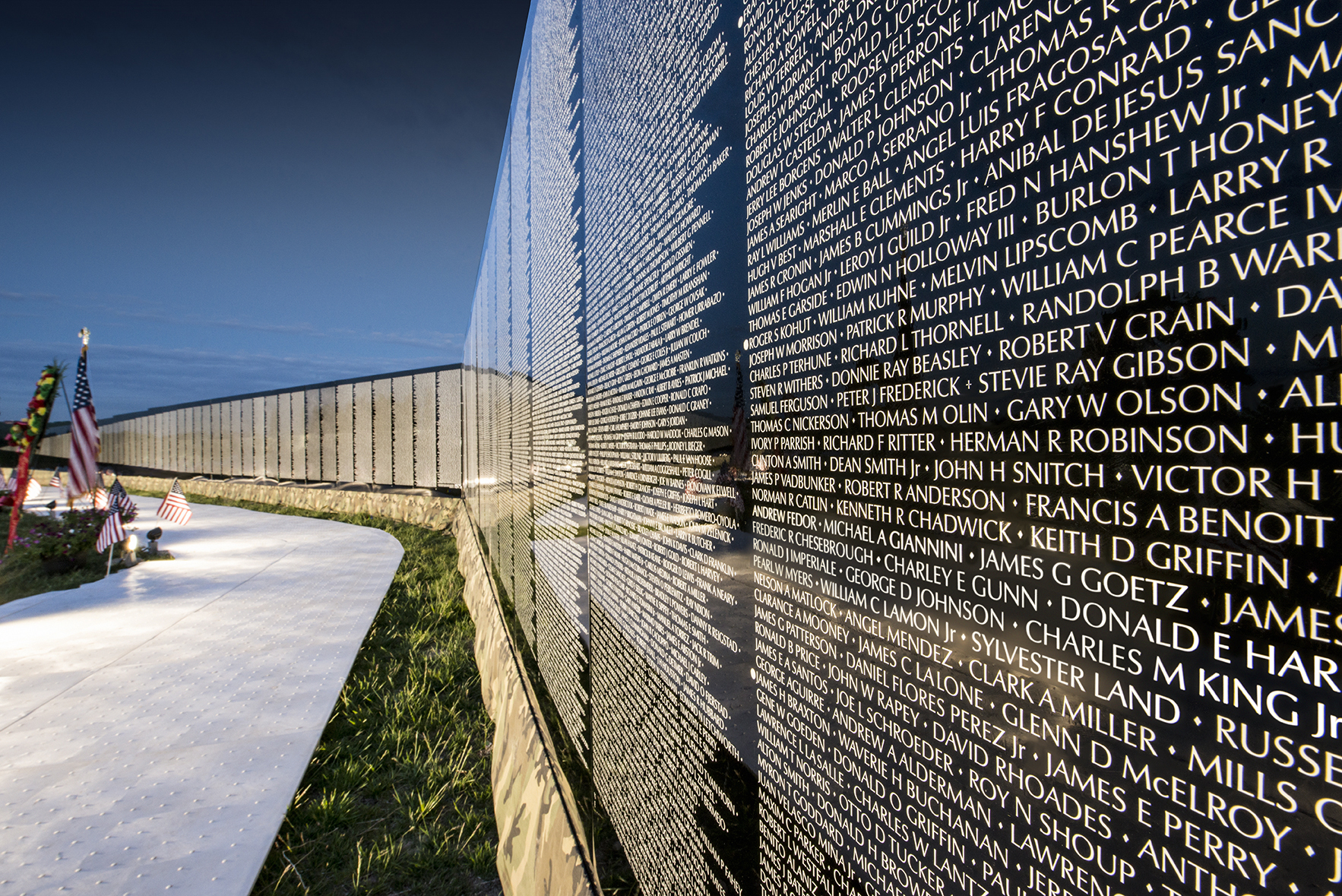
Maya Lin, Vietnam Veterans Memorial, 1982
Just seven years later, a 144 panel black stone memorial designed by Maya Lyn, was built just a short walk from the Korean Memorial. This Vietnam Veterans Memorial named those 58,320 Americans who lost their lives in the Vietnam War, a conflict that lasted over ten years. The Wall, completed in 1982 allowed visitors walking the length of the memorial start at ground level, descend below it, and ascend back to ground level. This is symbolic of a “wound that is closed and healing.” Reflections of visitors in the dark stone add another layer of depth to the meaning–we are the living remnants of those who died in a controversial war.
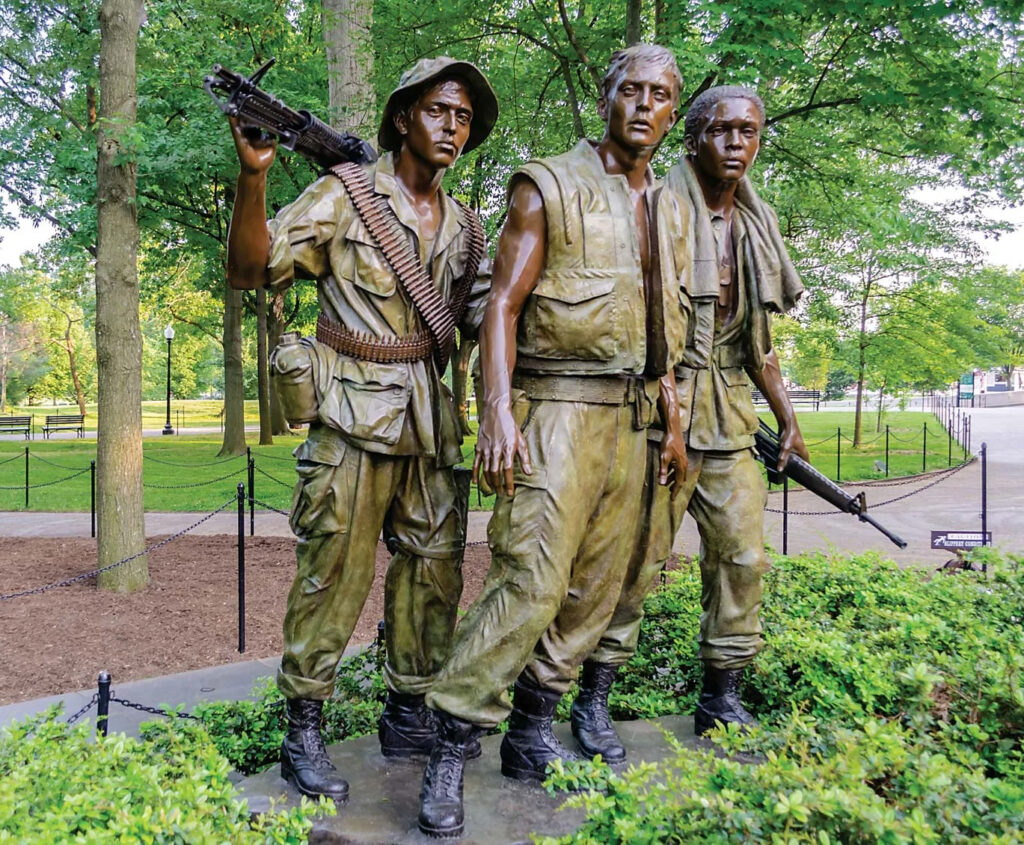
Frederick Hart, Three Soldiers, 1984
Eleven years after it was supplemented with the statue Three Soldiers in 1984. Sculptor Frederick Hart described the sculpture, “The contrast between the innocence of their youth and the weapons of war underscores the poignancy of their sacrifice. There is about them the physical contact and sense of unity that bespeaks the bonds of love and sacrifice that is the nature of men at war…Their strength and their vulnerability are both evident.”
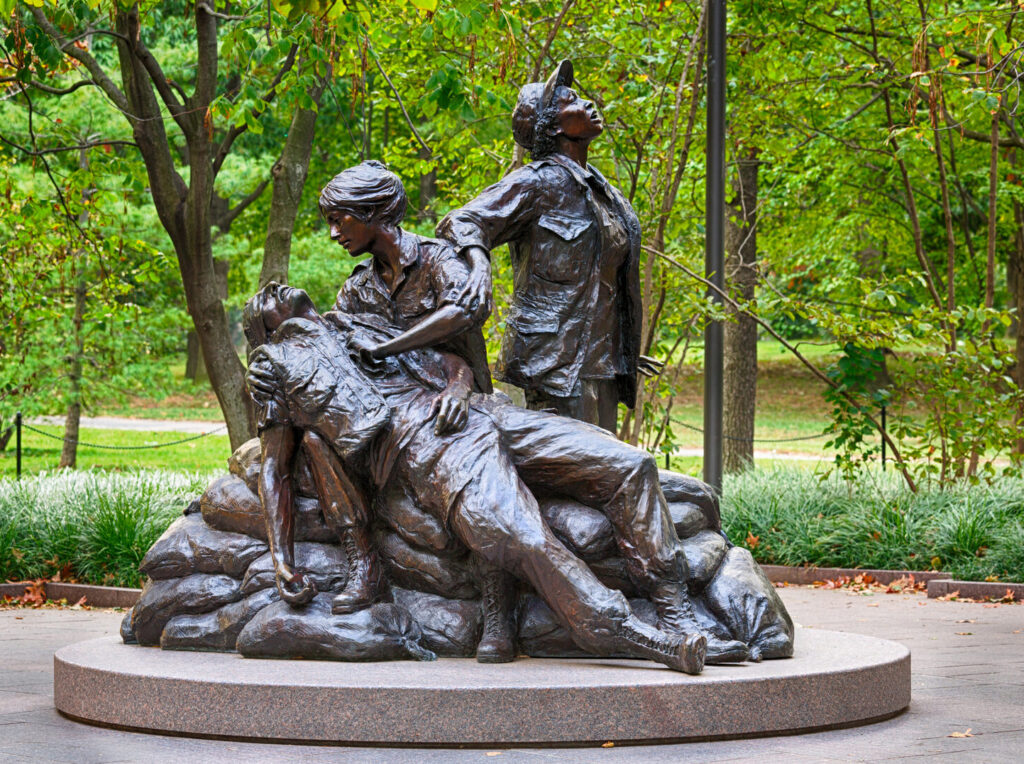
Glenna Goodacre, Vietnams Women’s Memorial, 1993
An additional figurative supplement is the Women’s Vietnam Memorial designed by sculptor Glenna Goodacre in 1993. Figures of three uniformed combat nurses care for a wounded soldier. The memorial recognizes the approximately 11,500 American military women were stationed in Vietnam during the war. Ninety percent were nurses. Others served as physicians, physical therapists and personnel in the medical field, air traffic control, military intelligence, administration and in many other capacities. Civilian women also served in Vietnam as news correspondents and workers for the Red Cross, the USO, Special Services, the American Friends Service Committee, Catholic Relief Services and other humanitarian organizations.
With the addition of these two figurative sculptures, the Vietnam Veterans Memorial was completed.